Poco F9 Ultra review
Verdict
In-depth review of the Poco F9 Ultra
Introduction, specs, unboxing
Introduction
While many still might not instantly associate Poco with a proper flagship offering, the company's F series has been delivering impressive flagship and "flagship-killer" devices ever since the original Poco F1 back in 2018. Better still, there often seems to be a "GT", "Pro", or, more recently, "Ultra" model in the F lineup that pushes the envelope even further. And that's exactly where we find the Poco F9 Ultra we have for review today.
The Poco Ultra models aren't exactly what you would call cheap in absolute terms. Sure, with constantly ballooning smartphone prices, we have to accept the reality we live in. Whether we like it or not, and regardless of whether we decide to blame it on the current memory chip situation, another psychological barrier has now been crossed - "budget flagships" or "flagship killers" like this here Ultra have officially ventured beyond the €1,000 mark.
Sure, there will be promos and kickbacks and likely early-bird specials, but even so, last year's Poco F8 Ultra launched at €829 for the 12GB/256GB model. So, the price hike is real.
Xiaomi Poco F9 Ultra specs at a glance:
- Body: 163.5 x 77.9 x 8.7 mm, 235g; Glass front (Gorilla Glass 7i), aluminum frame, glass-fiber reinforced plastic back; IP68 dust-tight and water-resistant (submersible up to 1.5m for 30 min).
- Display: 6.90" AMOLED, 68B colors, 185Hz, Dolby Vision, HDR Vivid, HDR10+, BT.2020, 10,000 nits (peak), 1200x2608px resolution, 19.56:9 aspect ratio, 416ppi.
- Chipset: Qualcomm SM8850-AC Snapdragon 8 Elite Gen 5 (3 nm).
- Memory: 256GB 12GB RAM, 512GB 16GB RAM, 1TB 16GB RAM; UFS 4.1.
- OS/Software: Android 16, up to 4 major OS updates, HyperOS 3.
- Rear camera: Wide (main): 200 MP, f/1.7, 24mm, 0.5µm, PDAF, OIS; Telephoto: 50 MP, f/3.0, 120mm, 1/2.75", 0.64µm, PDAF, OIS, 5x optical zoom; Ultra wide angle: 50 MP, f/2.4, 18mm, 102-degree, 1/2.88", 0.61µm.
- Front camera: 32 MP, f/2.2, 21mm (wide), 1/3.44", 0.64µm.
- Video capture: Rear camera: 8K@30fps, 4K@30/60fps, 1080p@30/60/120/240/960/1920fps, gyro-EIS, HDR10+; Front camera: 4K@30fps, 1080p@30/60fps.
- Battery: 8050mAh; 100W wired, PD3.0, QC3+, 100W PPS, 50W wireless, 27W reverse wired, 22.5W reverse wireless.
- Connectivity: 5G; eSIM; Wi-Fi 7; BT 6.0, LHDC 5.0, ASHA, MIHC, Auracast; NFC; Infrared port.
- Misc: Fingerprint reader (under display, ultrasonic); 2.1 stereo speakers with a subwoofer.
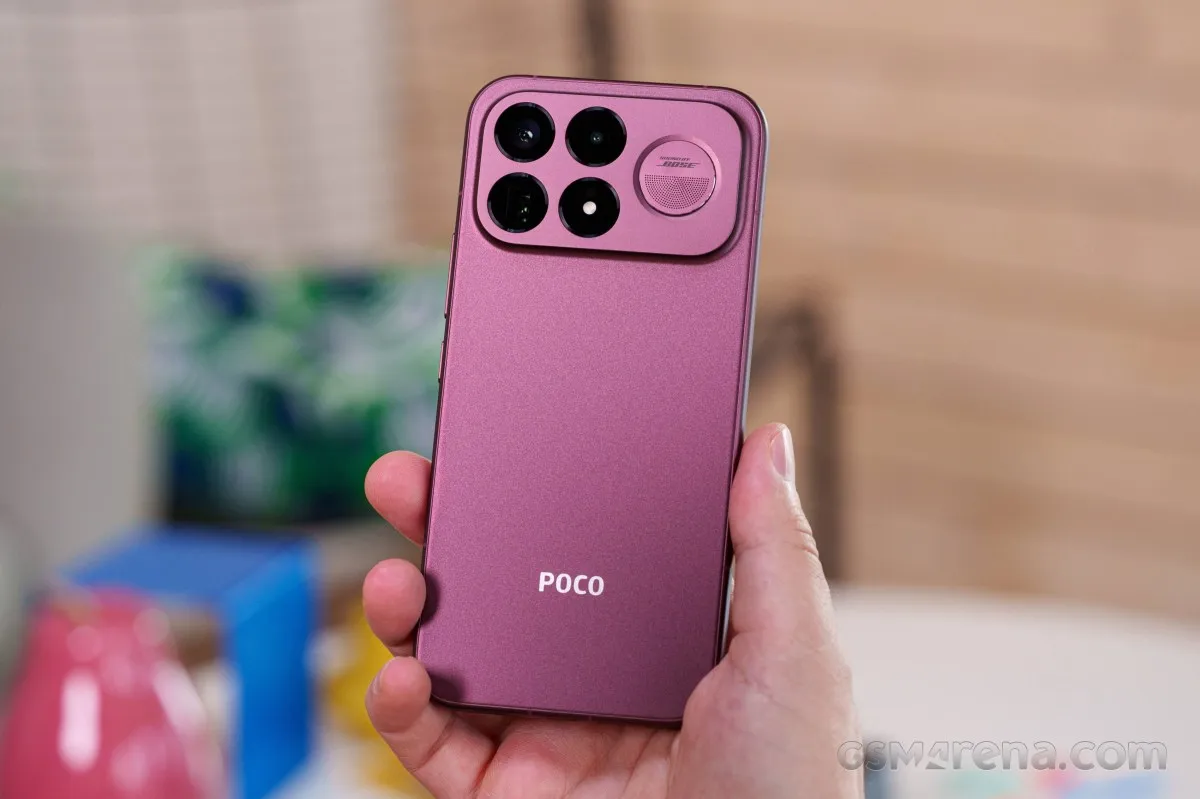
The Poco F9 Ultra is not only an excellent flagship device, based on the still top-dog Snapdragon 8 Elite Gen 5 chipset, with very few other spec compromises; it even goes a step further by actually introducing interesting new and added-value features to the mix.
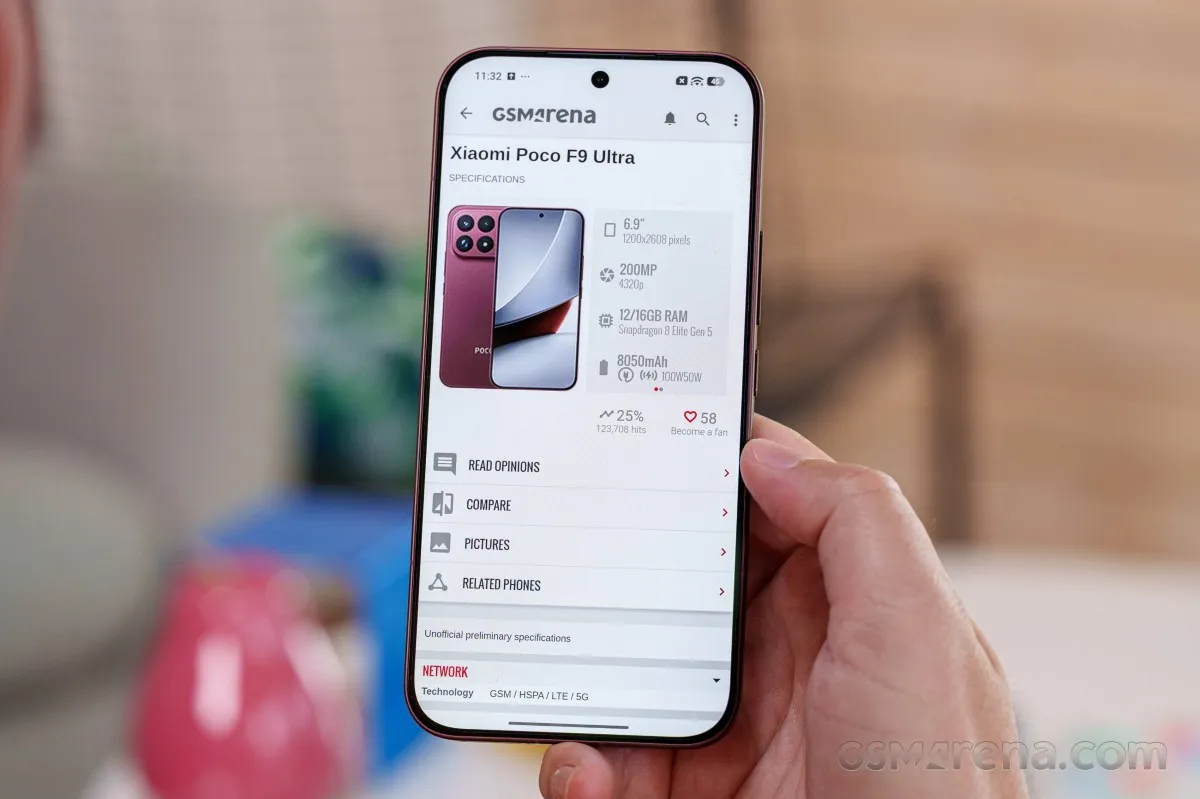
We will be sure to go into more detail on every point here, but just to name a few highlights: The large 6.9-inch display is insanely bright and also very fast with a 185Hz refresh rate and a dedicated display chip that can do both frame interpolation and dynamic resolution, as well as decreased motion blur. And, according to Poco, the F9 Ultra actually marks the global debut of the M11 generation OLED panel.
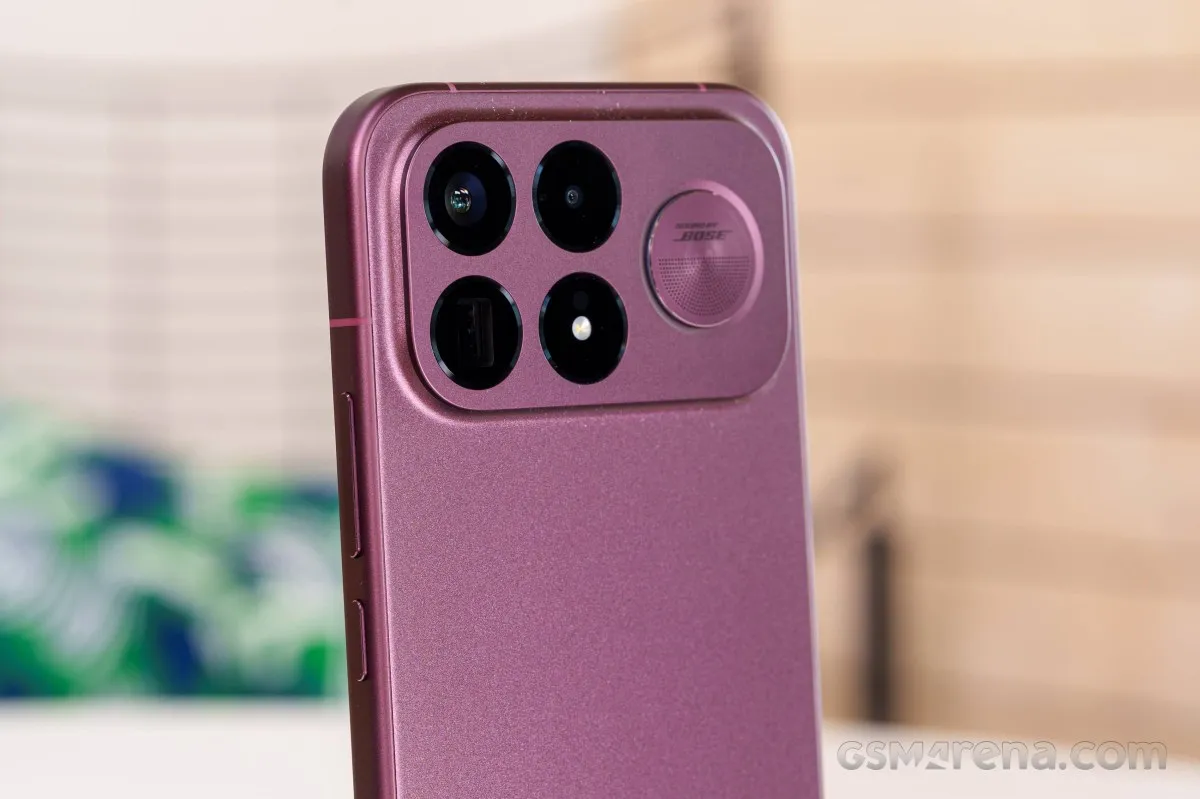
Then there is the ongoing BOSE partnership. Not only does the F9 Ultra deliver dual symmetrical stereo speakers, but there is actually a separate subwoofer on the back side, making for a rather unique 2.1 speaker setup. That's definitely not something you see every day. Well, to be fair, last year's Poco F8 Ultra already had essentially the same feature, but it is still unique in the broader industry sense.
And the goodies don't stop there either. The F9 Ultra is powered by a huge 8,050 mAh battery - the biggest capacity on a Poco F series so far. Poco packed a frankly insane capacity into a relatively small volume with the help of relatively high 16% silicon-carbon content. And as a cherry on top, the Poco F9 Ultra can do a whopping 100W of wired charging, 55W wireless charging and fast wired and wireless reverse charging.
We are clearly excited to dig our teeth into the F9 Ultra, but first, the unboxing.
Unboxing
We've said it before, and we'll say it again - there are much better ways to make a statement, other than a flashy box. Thankfully, the industry has mostly moved away from that trend of old, with very rare exceptions, and Poco was never one to overspend on cardboard.
The box is your standard two-piece affair. The bottom half and most of the insides are actually done in Poco's signature yellow. There are some matching accents on the top black piece, which makes for a nice dual-tone look. Everything is sturdy enough to protect the phone during transit.
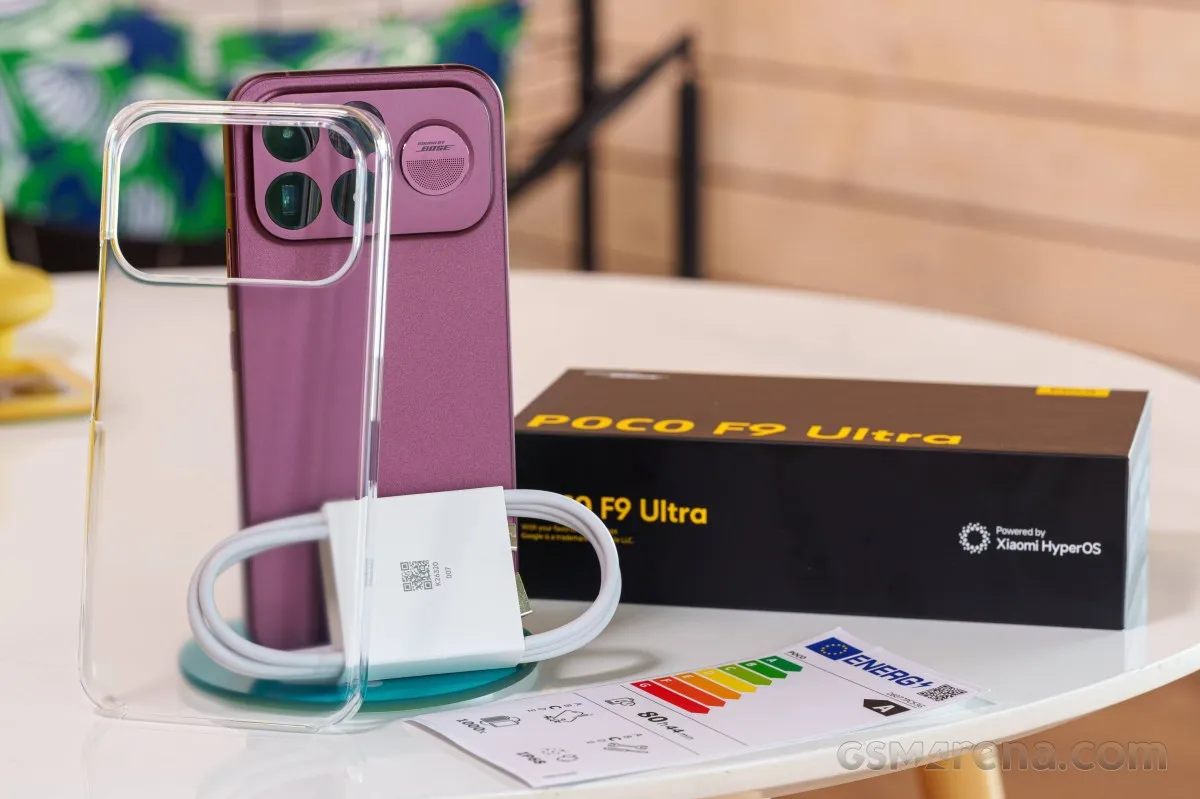
There is no charger in the box, definitely not in our European unit. Those days are officially gone. Poco does still include a USB Type-A to Type-C charging cable. It is one of the company's non-standard orange-tipped ones with an extra pin, presumably meant to be used with something like the Xiaomi 100W HyperCharge charger.
Also in the box is a nice, thick, hard, transparent case for the F9 Ultra. Not a bad added value these days.
Design, build quality, handling
Design, build quality, handling
Our first impression of the F9 Ultra is frankly that it is quite a hefty phone. It tips the scales at 235 grams. That's a lot for a smartphone. Then again, it has a 6.9-inch display and an 8,050 mAh battery still, and it fits pretty naturally in the hand, which is made easier by the rounded edges of the frame.
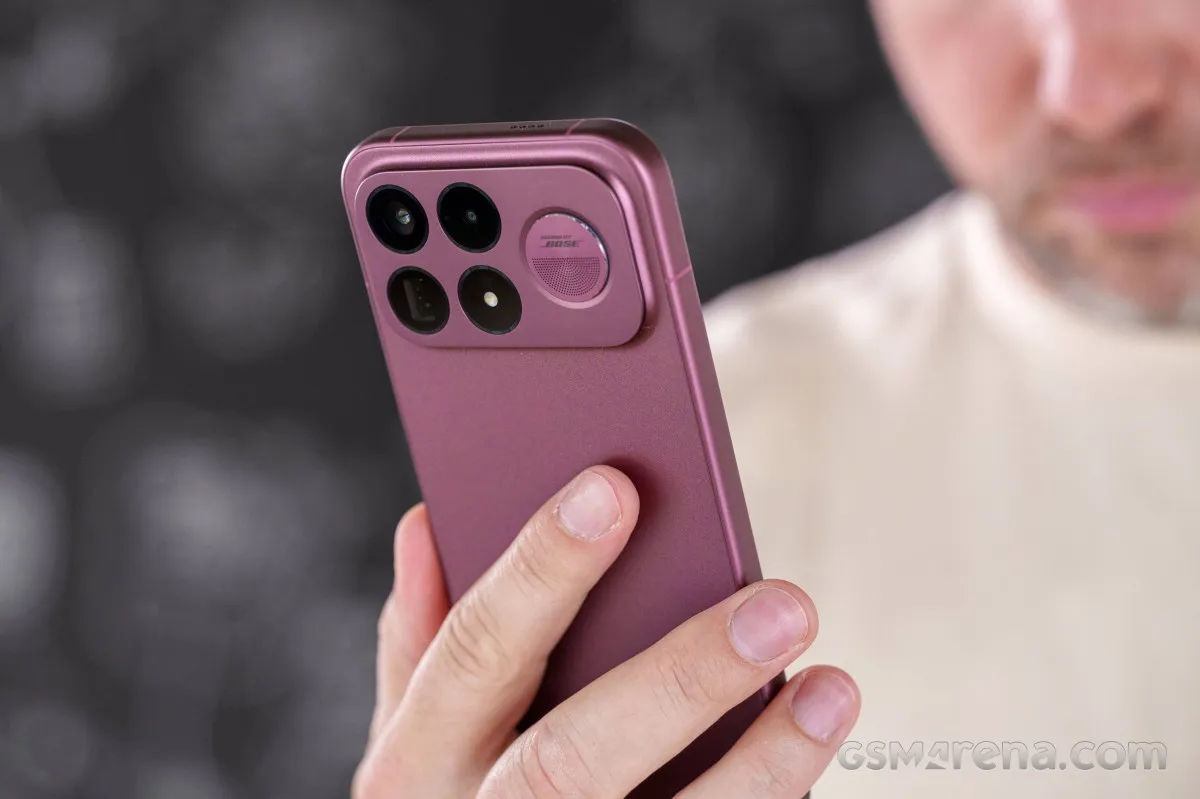
The F9 Ultra mostly follows current design trends. The sides are large and almost flat. Not completely, though. There is a bit of a bulge there. All four corners are aggressively curved, and said curvature is transferred over to the display as well. The front and back sides are both perfectly flat.
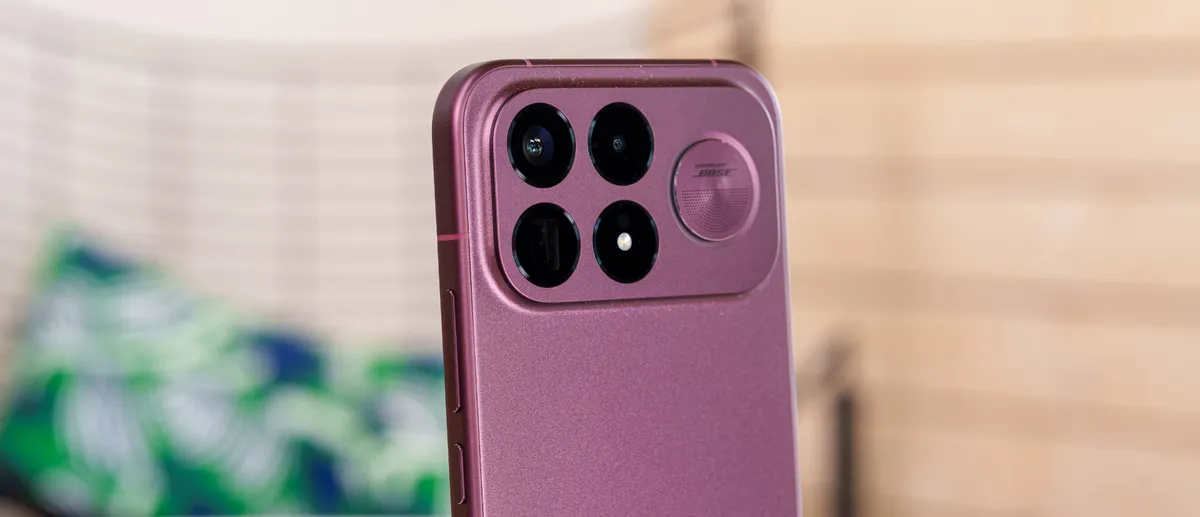
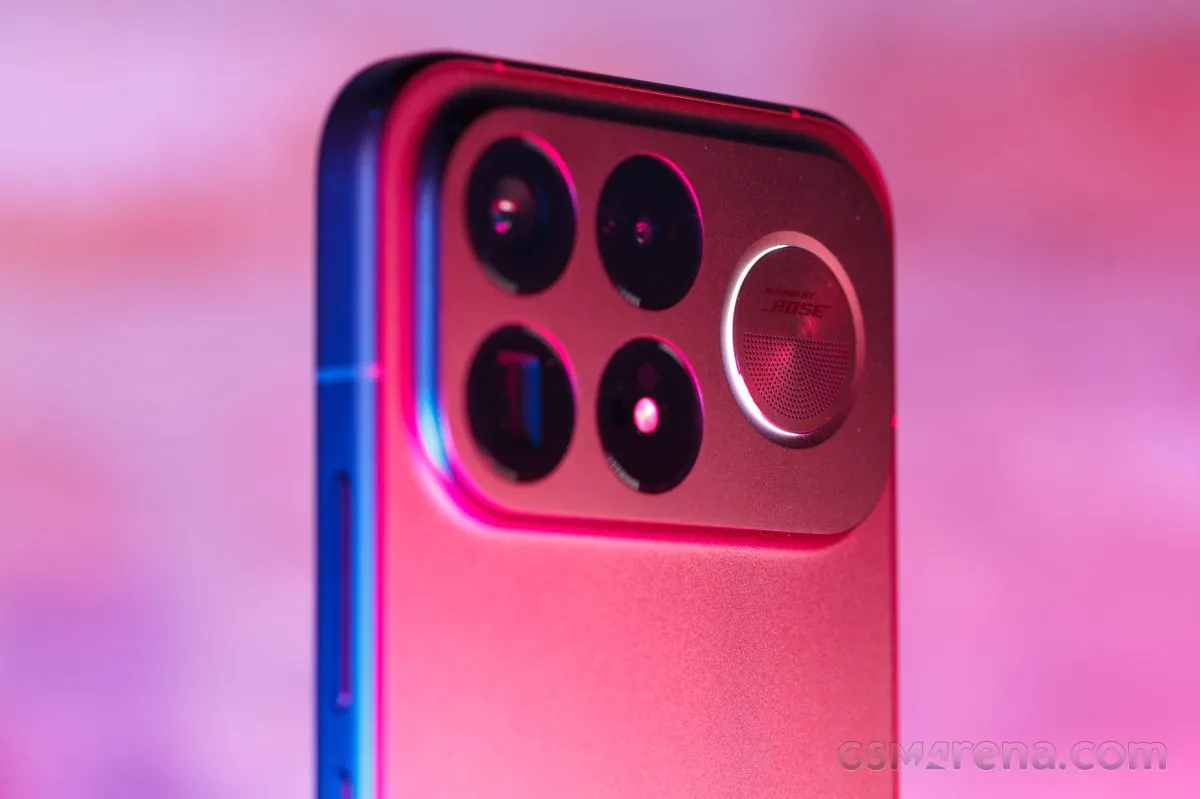
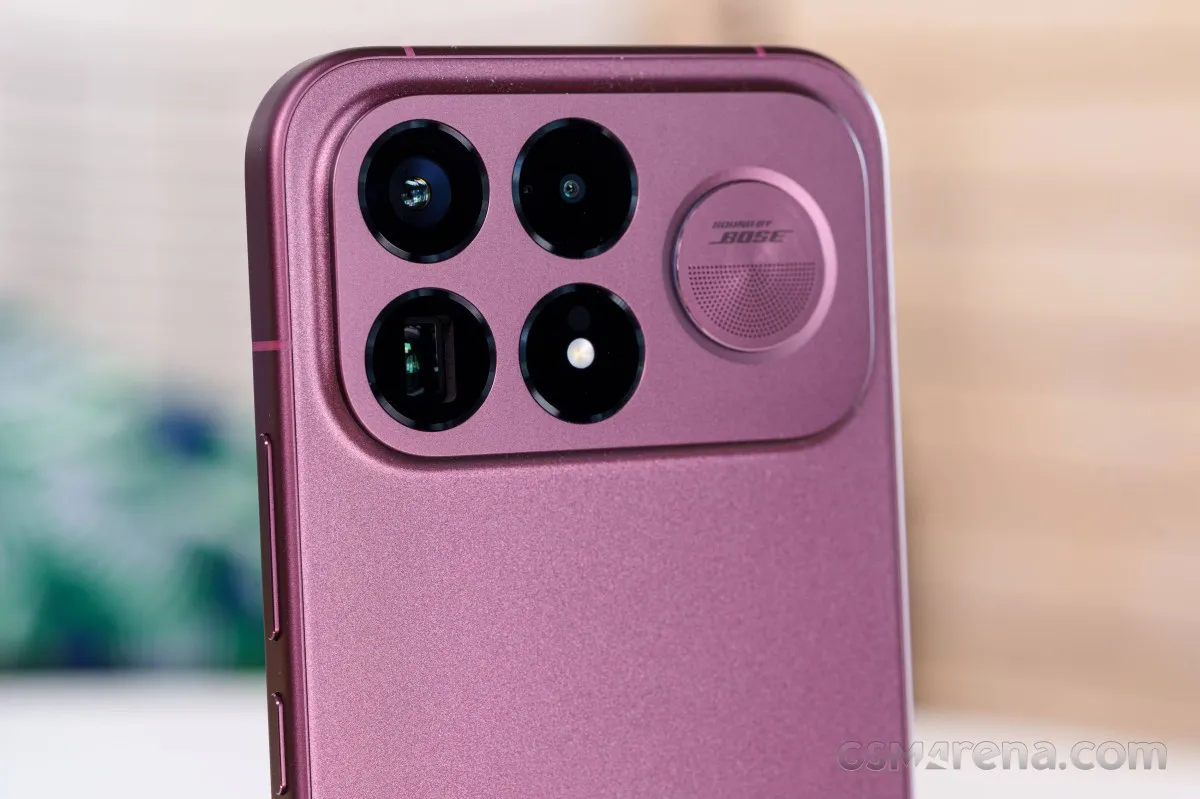
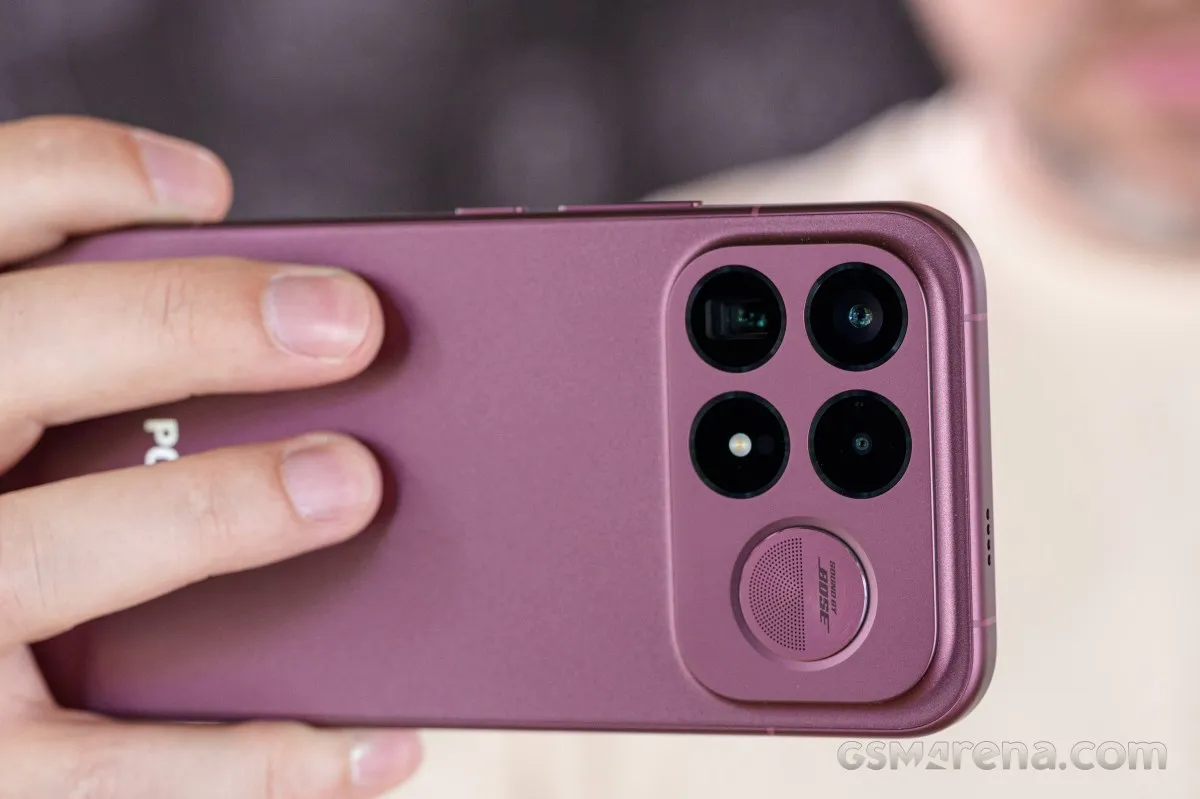
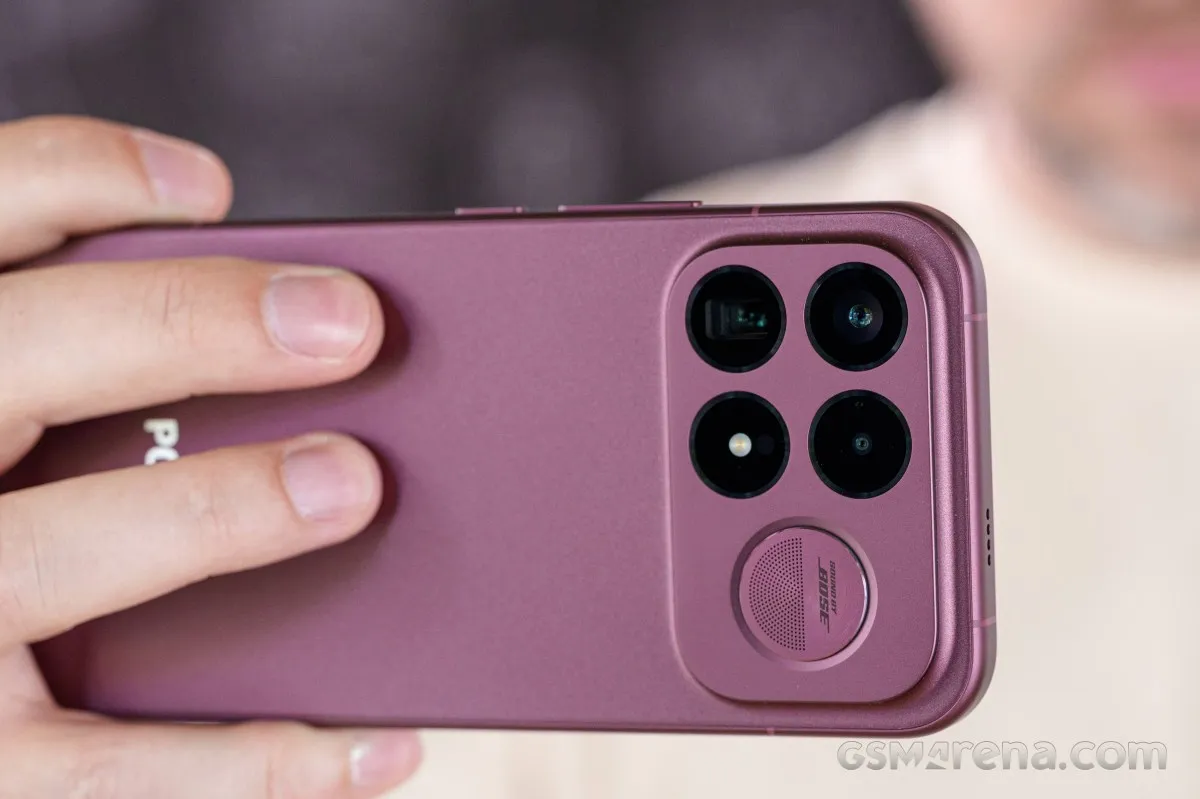
Since we are touring the phone already, we might as well take a look at the controls. There is nothing out of the ordinary, well, perhaps save for the separate subwoofer on the back of the camera island, branded as "Sound by BOSE".
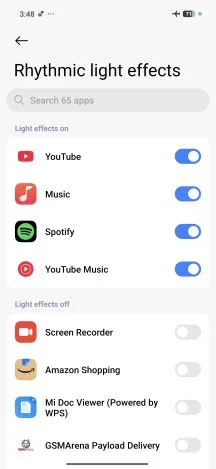
Speaking of the subwoofer, Poco actually hid an LED light ring around its rim. Honestly, we almost missed it ourselves. It is quite cool.
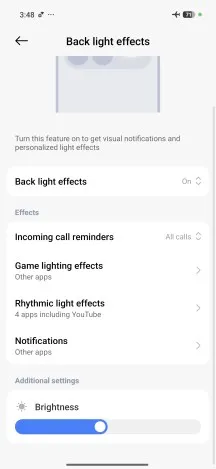
You can adjust its brightness, use it as a notification LED, have it pulse to the beat of music or even react to some in-game actions. Though that only seems to work with PUBG and Call of Duty at the moment.
The camera island is quite prominent, but interestingly we found it rarely gets in the way. By being symmetrical and extending from one end of the phone to the other, it also does not introduce any wobble while the phone is on a flat surface. It does stick out quite a bit, but we get it; Poco needed the space for the periscope telephoto camera. There is a hidden IR blaster on the back, next to the LED flash, in case you were wondering.



There is nothing on the left side of the frame, and a standard power button and volume rocker sit on the right side. The buttons seem to be made of metal like the surrounding frame, which is a nice touch. The buttons are nice and clicky with plenty of tactile feedback.
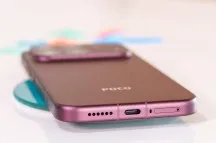
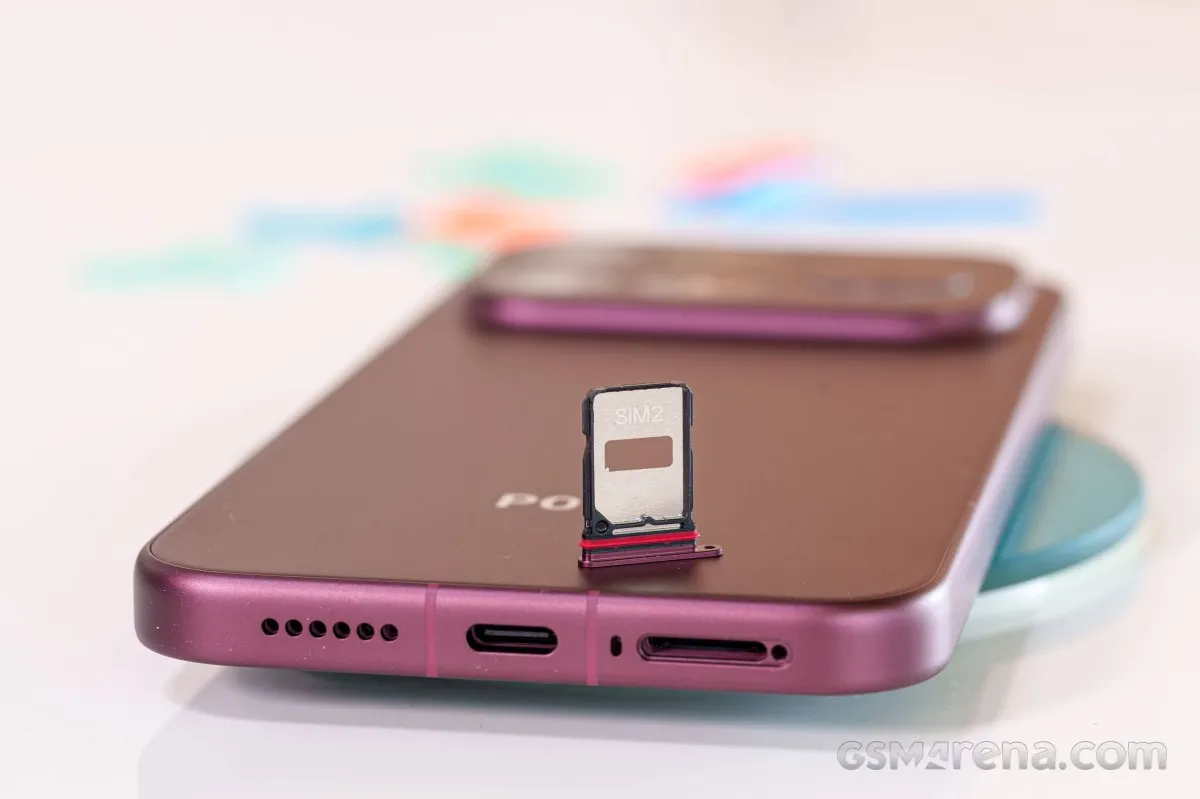
There are speakers on both the top and bottom of the phone. These are symmetrical in terms of the actual speakers, even though the speaker grills aren't identical. The bottom side also houses the SIM tray and the Type-C port. Nothing out of the ordinary.
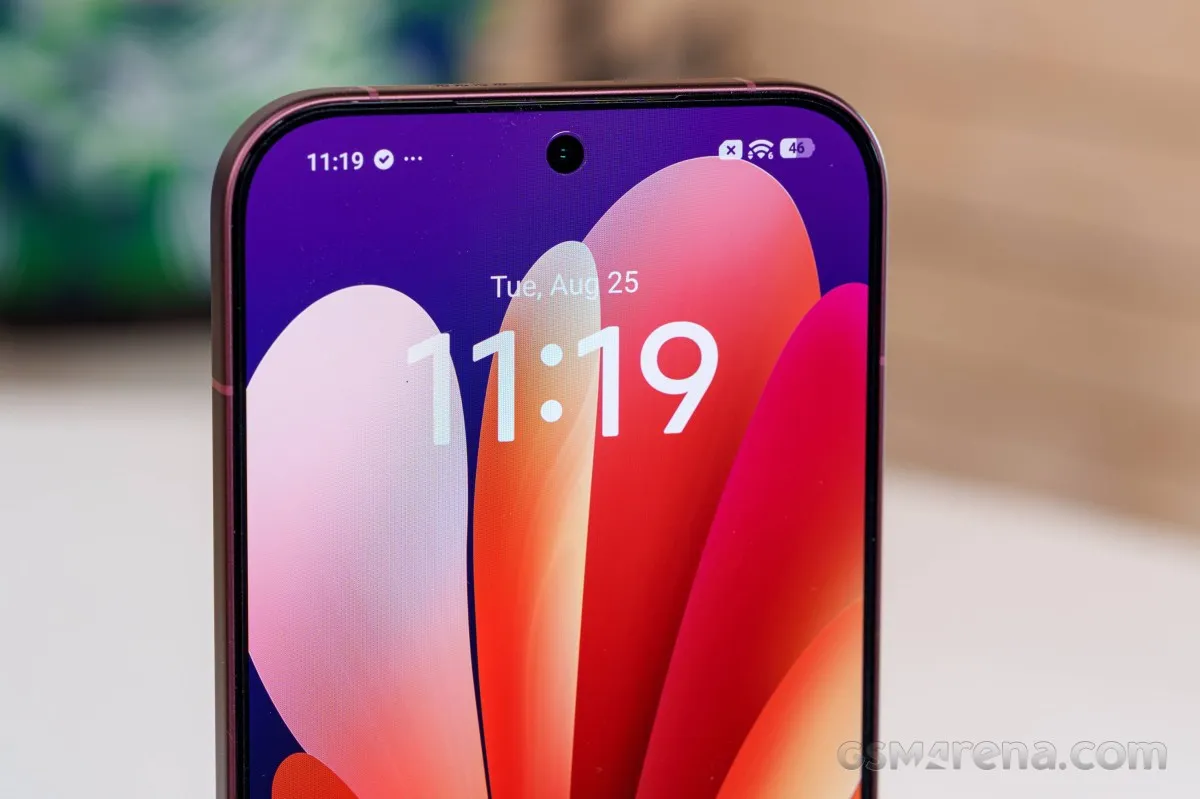
The display bezels are pretty thin. Far from the thinnest we've seen, but still quite thin. The same can be said about the selfie camera punch hole - it is reasonably tight, but we've seen better. Poco still found enough room for a mostly hidden earpiece above the display.
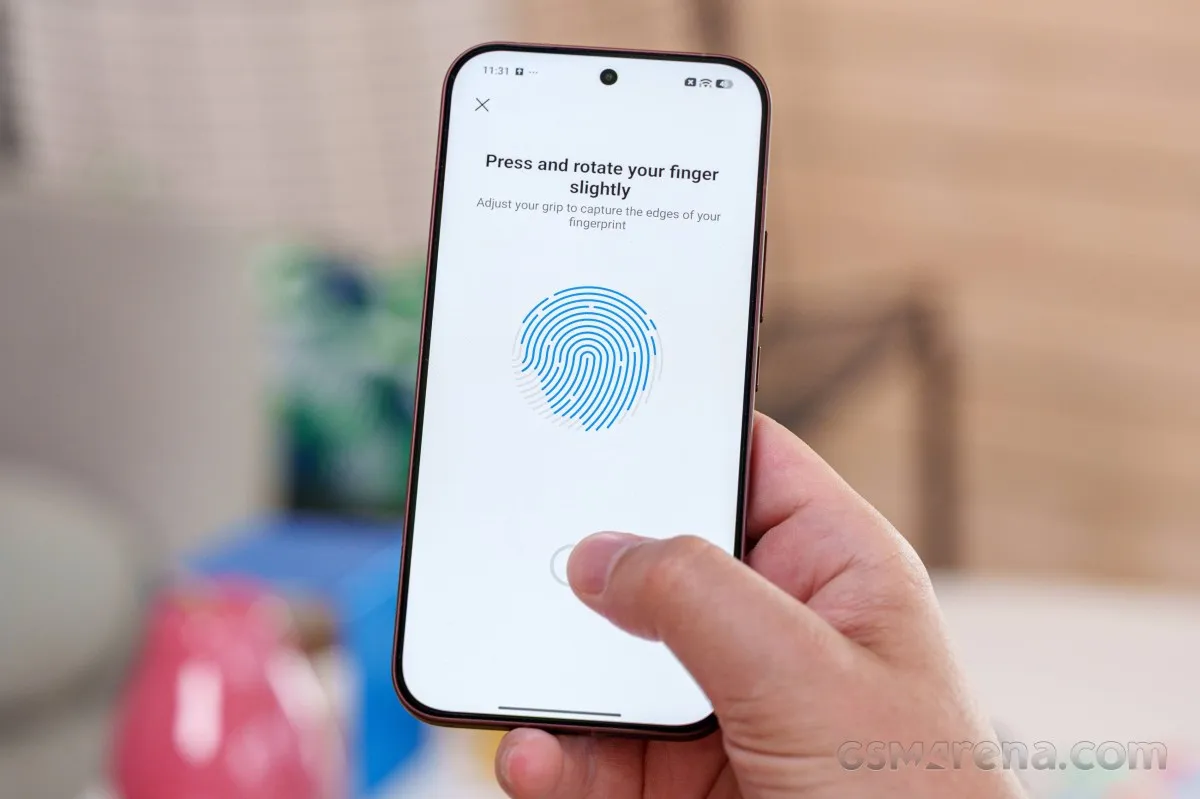
The F9 Ultra uses an ultrasonic in-display fingerprint reader - another subtle detail that indicates its true flagship ambitions. The reader is as snappy and accurate as you would expect.
Speaking of premium touches, the overall build of the F9 Ultra is nothing but premium. The frame is made from aluminum. The back is made of super smooth glass-fiber reinforced plastic, while the front is covered with Gorilla Glass 7i. The whole thing feels really dense and hefty and seems to be built like a tank.
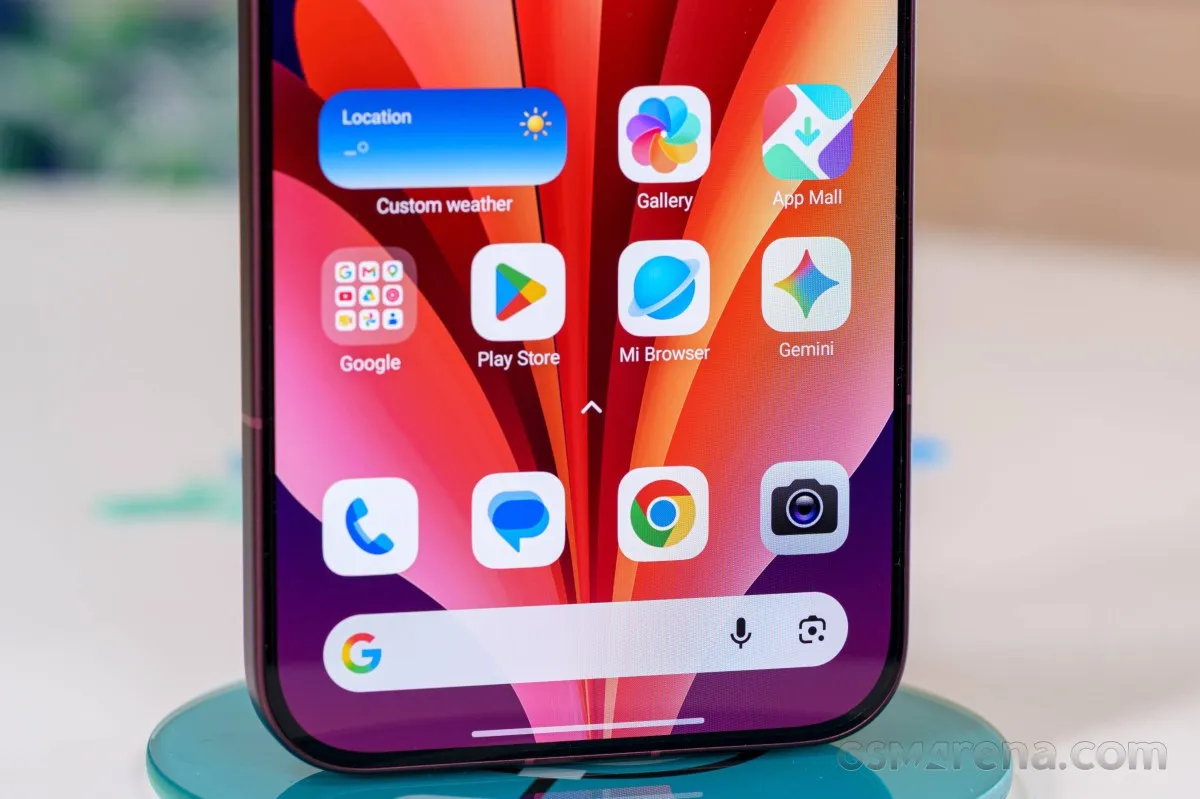
Naturally, as expected, there is IP68 ingress protection.
The Poco F9 Ultra can be had in either Black or the Dark Cherry our review unit came in. It seems Xiaomi jumped the trend with this one and we'll be seeing much more of this hue, if the rumors about it being the hero color of the upcoming iPhones turn out to be true.
Our lab tests - display, battery life, charging speed, speaker
Display
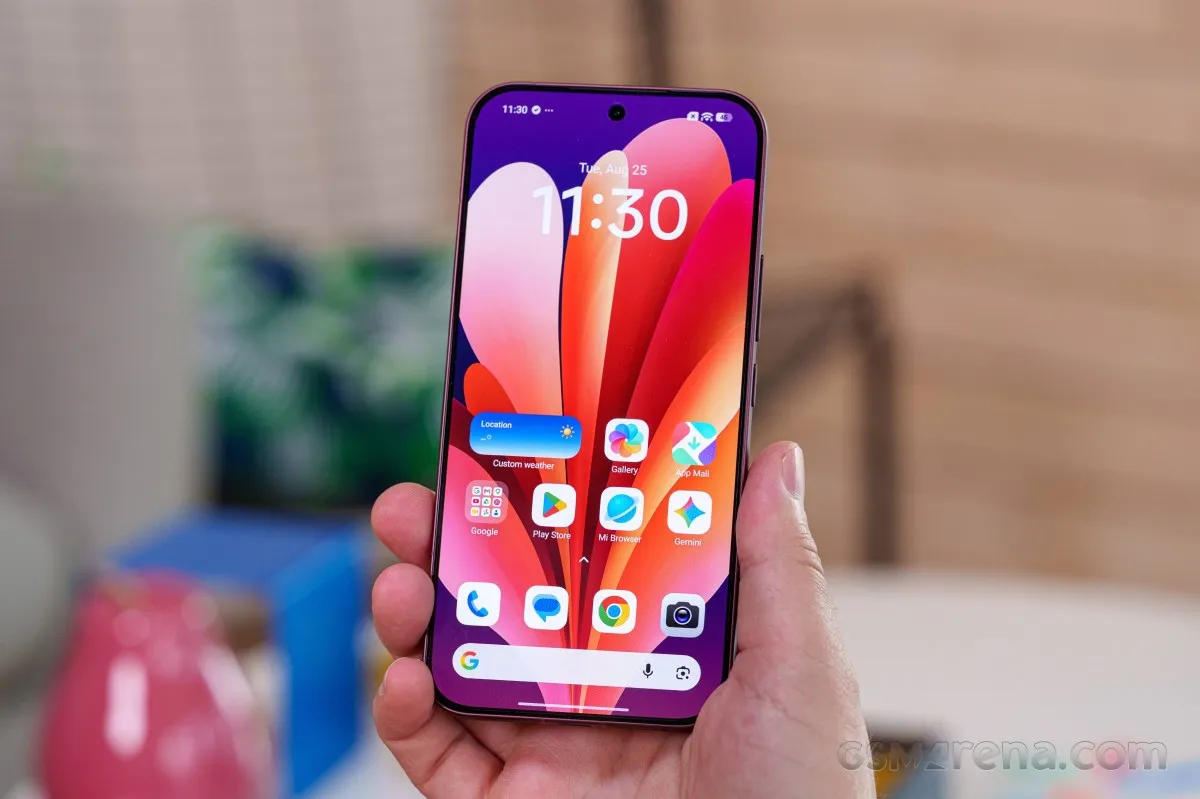
The display is a real highlight of the Poco F9 Ultra package. First off, it's pretty big at 6.9 inches across, in the popular 19.5:9 aspect ratio. The resolution is 1200 x 2608 pixels, which at this diagonal results in an admirable pixel density of around 416ppi.
The F9 Ultra has what Xiaomi calls HyperRGB technology. In simpler terms, its OLED has a full RGB subpixel structure. This is sure to have its benefits, though they might be in places that are harder to spot with the naked eye, like improved power efficiency and possibly a thinner display panel profile.
Poco says the panel here has increased green pixel luminous efficiency by 20%, which in turn has allowed them to push very high brightness numbers. High Brightness Mode (whole display) is advertised as reaching 2,500 nits, which is already impressive. Apparently, a 25% window can reach 4,500 nits, and a 1% area should be able to blast at up to 10,000 nits.
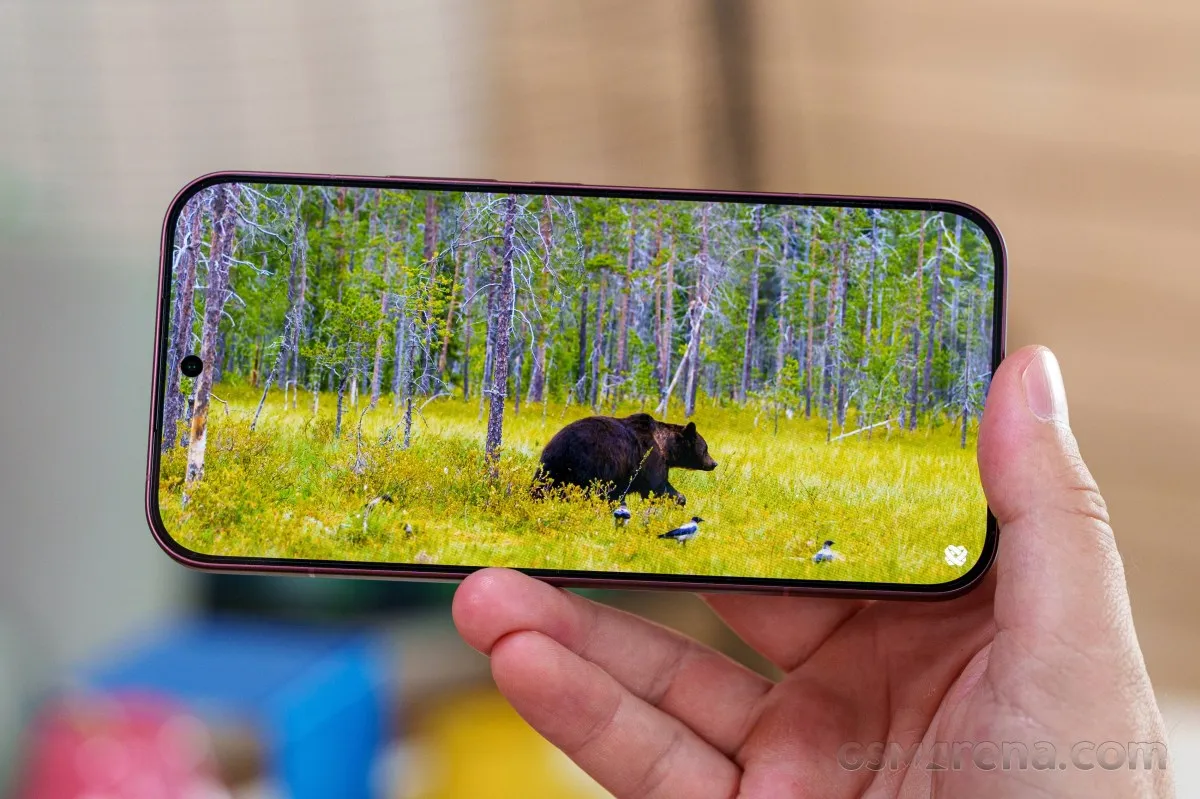
Our testing confirmed that the Poco F9 Ultra can get very bright - almost ridiculously so. A 75% window got us a very reasonable 1,283 nits, which is perfectly usable outdoors. But the phone is clearly capable of much, much more since in our 10% window measurement, we already got a whopping 4,333 nits.
The minimum brightness we measured at point white was an impressively low 1 nit.
The F9 Ultra also supports DC dimming too for those sensitive to the regular PWM way of adjusting brightness.
Max display brightness test
White test pattern (nits)
- Manual (75% fill)
- Auto (75% fill)
- Peak Auto (10% fill)




 Pixel 10 Pro XL
 Poco F7 Pro
 OnePlus 15
 Poco F9 Ultra
 OnePlus 15R
 Xiaomi 17T
 Xiaomi 17 Pro Max
A few words on colors, then. The panel supports 12-bit color depth and has DCI-P3 wide color gamut support. Xiaomi also has its own tech on top called Original Color PRO.
The Poco F9 Ultra advertises up to 185Hz refresh rate, which is quite impressive. However, it is a bit more complicated than just saying the display refreshes that high. What happens in reality is that most of the time the phone stays in 120Hz mode and occasionally drops to 60Hz to save power and when the on-screen content calls for it. The phone also supports a middle-ground 90Hz mode, but it gets little actual use.
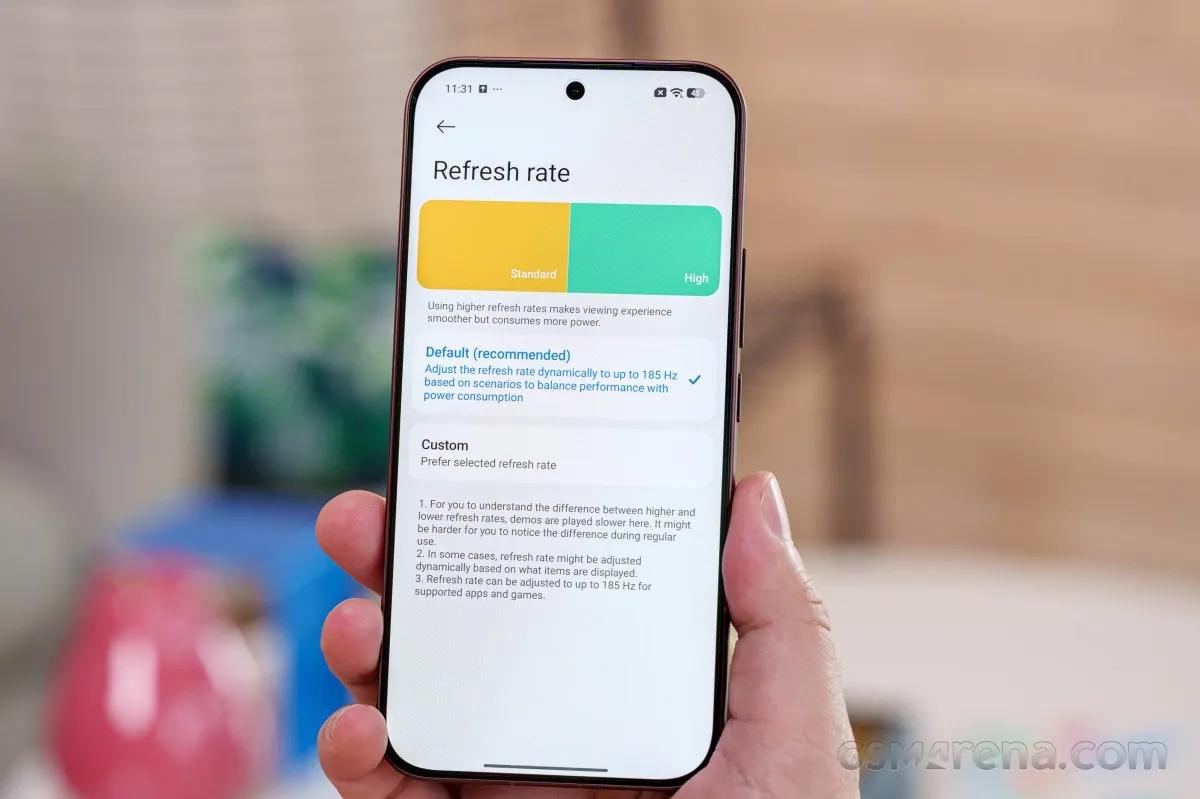
Poco doesn't really have overly complex content detection. Plus, the F9 Ultra doesn't seem to support any refresh rate steps below 60. So, for example, playing back a 24 fps or 48 fps video on YouTube, leaves the display at 60 Hz.
On the other end of the spectrum, the F9 Ultra officially reports support for 144Hz, 165Hz and 185Hz modes in Android, meaning it can do them natively. These, of course, are pretty much meant for gaming. Poco says that over 20 games support native rendering up to 185Hz at launch, but we don't have a formal game list to confirm.
Beyond true 185Hz support, there are apparently five more game titles that can achieve near-185fps rendering with the help of frame interpolation, including PUBG Mobile and Garena Delta Force.
That's the other thing we need to mention: the F9 Ultra actually has a dedicated display chipset. It is called the VisionBoost D8, and apparently it can handle a lot of image processing tasks, including the aforementioned frame interpolation. Using it seems to be absolutely optional since there is a toggle in settings.
Naturally, we tried our usual set of games that we know can render beyond 60fps. Indeed, pretty much all of them managed to stretch their legs up to 120fps/120Hz, as expected. This should make for an excellent gaming experience even if you don't get 185Hz across every game out there.
Rounding off the gaming section here, it is worth noting that the F9 Ultra advertises up to a 480Hz touch sampling rate, with an instant sampling rate of up to 4800Hz - pretty impressive.
The F9 Ultra is nothing short of a multimedia powerhouse, thanks to its dual symmetrical stereo speakers. As we said, it advertises an insane peak display brightness output of 10.000 nits, which makes for an especially compelling HDR experience.
The F9 Ultra has HDR certification for both Dolby Vision and HDR10+. It will more than happily decode any of the four popular HDR formats out there: Dolby Vision, HDR10, HDR10+ and HLG. And, as expected, it also has Google Widevine L1 DRM certification, allowing apps like Netflix to offer up Full HD streams. Like we said - a multimedia powerhouse that chews through absolutely anything you throw its way.
Battery life
The Poco F9 Ultra has a pretty large 8,050 mAh battery. Hence, we expected nothing short of an excellent Active Use Score going into this portion of testing, and indeed, it did not disappoint. Frankly, not accounting for certain fringe devices out there, this is about the ballpark battery endurance you can expect from a regular modern smartphone.
The Poco F9 Ultra's scores aren't even too far off from those of the Poco X8 Pro Max - a device with a bigger-still 8,500 mAh battery. That's a pretty good achievement in our book.
Charging speed
The Poco F9 Ultra is rated for 100W charging using Xiaomi's proprietary HyperCharge technology, same as last year's model. Generally speaking, larger batteries also tend to charge faster, as they can take higher currents, though it's not exactly as simple when dealing with modern Si/C chemistry.
Using a 100W Xiaomi charger, the F9 Ultra charged from 1% to 32% in 15 minutes, reached 61% by the 30-minute mark, and took a little under an hour for a full charge.
That may not sound terribly fast but with the F9 Ultra's gargantuan battery capacity of 8,500 mAh, that's equivalent of charging over 4,900mAh in 30min. So it's a respectable showing nonetheless. What's confusing is that phones like the Redmi Note 17 Pro Max and Xiaomi 17T Pro support a faster mAh/min charging rate with the same 100W charger.
Charging speed
- in 15 min
- in 30 min
- Time to full charge (from 0%)
 Poco F7 Ultra
 vivo X300
 vivo X300 Ultra
 Poco X8 Pro Max
Pixel 10 Pro XL
Poco F9 Ultra
Xiaomi 17T
Poco X8 Pro Max
Pixel 10 Pro XL
Poco F9 Ultra
Xiaomi 17T
The Poco F9 Ultra also supports 50W wireless charging, though that might only be achievable with an in-house charger and 22.5W reverse wireless charging. It can also do up to 27W reverse wired charging.
There's a good set of provisions for extending the lifespan of the battery available in the HyperOS settings. You can choose between 'Standard' and 'Top speed' modes for the wired charging. You can enable Smart charging, which boosts the charging process only when you are starting from a lower percentage.
You can also have the battery charge up to 80% and then wait for the final top-off just before you typically use it, based on your usage patterns. Alternatively, you can just set a hard cap on things at 80% in all situations by enabling the Battery protection toggle.
Speakers - loudness and quality
A great display gets you a lot of the way to a great multimedia experience, but audio is also very important. Thankfully, Poco did not ignore it at all. First and foremost, there are the two symmetrical stereo speakers, both 1115D in size, which is the same as last year, but still very impressive. Poco calls these "master-grade". Then there is the separate subwoofer. It is styled a bit differently than last year's model, but on the inside it seems to be the same or a very similar 1620 unit.
The top speaker of the Poco outputs simultaneously upwards through an opening in the frame and forward through a slit above the display (so it can serve as an earpiece too), while the bottom one fires just towards the bottom.
The 'subwoofer' fires out the back and it gets some of both tracks, but then each speaker also plays back the other channels' track at a lower volume anyway.
The channels are assigned dynamically to the speakers depending on the handset's orientation in space, with the top speaker getting the left channel when the phone is held vertically.
Poco seemingly isn't too worried about sheer volume. Last year's F8 Ultra technically squeezed its way into a VERY GOOD rating in our testing but just barely. We did a few measurements on the F9 Ultra and ultimately ended up with a flat -26.0 rating, which, according to our scale, is at the very top end of the "GOOD" rating. Still, it's a very small difference within the margin of error for this test.
Listening to the recordings, the two phones appear identical in loudness and have enough of it for a satisfactory personal multimedia experience.
More importantly, the F9 Ultra sounds really good. We would call the overall quality excellent. Mids are exceptionally clean, and so are highs. The F9 Ultra also has surprisingly good low-end response for a phone. Things sound deep and impactful.
Poco has also worked on some gaming-specific tuning, and things like shots in FPS games sound immersive. Footsteps get a deliberate boost as well to help players. Overall, the sound stage is very rich, and audio remains one of the key potential selling points for the "Ultra" model.
Use the Playback controls to listen to the phone sample recordings (best use headphones). We measure the average loudness of the speakers in LUFS. A lower absolute value means a louder sound. A look at the frequency response chart will tell you how far off the ideal "0db" flat line is the reproduction of the bass, treble, and mid frequencies. You can add more phones to compare how they differ. The scores and ratings are not comparable with our older loudspeaker test. Learn more about how we test here.
Connectivity
The Poco F9 Ultra is a 5G device. It supports SA/NSA Sub-6 connectivity on up to two SIM cards simultaneously. The phone has two physical Nano-SIM slots and also supports eSIM. So, you can either use two physical SIM cards, two eSIM subscriptions or a mix with one physical and one digital SIM. Your choice.
Location services are stacked: GPS (L1+L5), BDS (B1I+B1c+B2a), GALILEO (E1+E5a), QZSS (L1+L5), NavIC, GLONASS. The same can be said about local connectivity. Well, perhaps with the one notable omission of 6GHz Wi-Fi support. You still get Wi-Fi 7, just not access to the new, uncongested band. The Bluetooth radio, however, is nothing short of impressive. It is version 6.0 with Dual-Bluetooth, LE support and fancy Auracast on top of that, plus ASHA for hearing aids. The stack also includes Xiaomi's own MIHC codec, plus LHDC 5.0 support. There is NFC on board, plus an IR blaster. No FM radio or 3.5mm audio jack, though.
The Type-C port is backed up by a USB 3.2 Gen 1 data connection. This standard was also marketed as USB 3.1 Gen 1 and USB 3.0 at different points in time. The important bit is that it allows for a theoretical data throughput of up to 5Gbps. Not too shabby. Of course, the F9 Ultra has Host/OTG support. It also has DP video output over USB Alt mode.
The F9 Ultra has a pretty full set of onboard sensors. There is a STMicro lsm6dsv accelerometer and gyroscope combo, an AKM ak0991x magnetometer and compass combo, a goodix 40964 light sensor and a Xiaomi-branded (v1.6) hardware proximity sensor, not a virtual one. There is no barometer on board.
Software and performance
HyperOS 3 on top of Android 16
Last year, the Poco F8 Pro and Ultra were the first two Xiaomi devices to debut HyperOS 3 on the global market. The F9 Ultra still ships with the same basic OS combo. In particular, our review unit is running 3.0.305.
Just like last year's models, the Poco F9 Ultra also comes with a software support promise of 4 major OS upgrades and a total of 6 years of security patches.
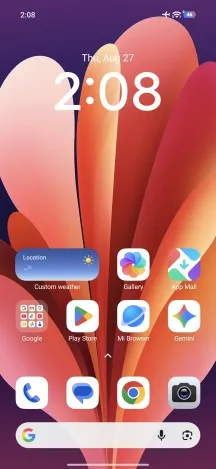
HyperOS 3 hasn't changed much visually from the previous generation, but there are a few notable developments. For instance, Xiaomi worked on the animations, which now appear to be a bit smoother and probably faster. System icons are also redesigned and are now flatter and simpler. There is actually an interesting toggle in display settings called "Advanced textures". It lets you toggle on or off rendering effects like blurring system-wide, which is a nice idea. Presumably going without fancier effects could make the UX a bit snappier and even save on some power.
So, nothing major has been introduced with the F9 generation, but we still think the so-called Hyper Island deserves a shoutout. It mimics Apple's Dynamic Island on iOS. Some of the apps that you run will minimize into a small pill-like bubble around the selfie camera, and you can quickly go back to that app when you need to. It also provides contextual information if available. For instance, music apps will show the album art of what's playing; if you set a timer, it will show you the time left; the voice recorder shows that you are still recording, etc.
Once you open more than one app, two bubbles will appear on top of the status bar, and you can cycle between the apps with a swipe.
HyperOS 3 also puts a stronger emphasis on cross-device connectivity. Xiaomi's HyperConnect suite already allowed users to share Wi-Fi credentials, files, screens, calls and notifications between Xiaomi devices signed in to the same Xiaomi Account.
With HyperOS 3, some of those features now extend beyond Xiaomi's own ecosystem. Compatible Android devices can join in, while Xiaomi has also added support for Apple devices, including iPhones and iPads, as well as Windows PCs and Macs.
Xiaomi even claims that users can view notifications and answer calls directly from an iPhone, iPad or Mac, making HyperConnect considerably less restrictive than before.
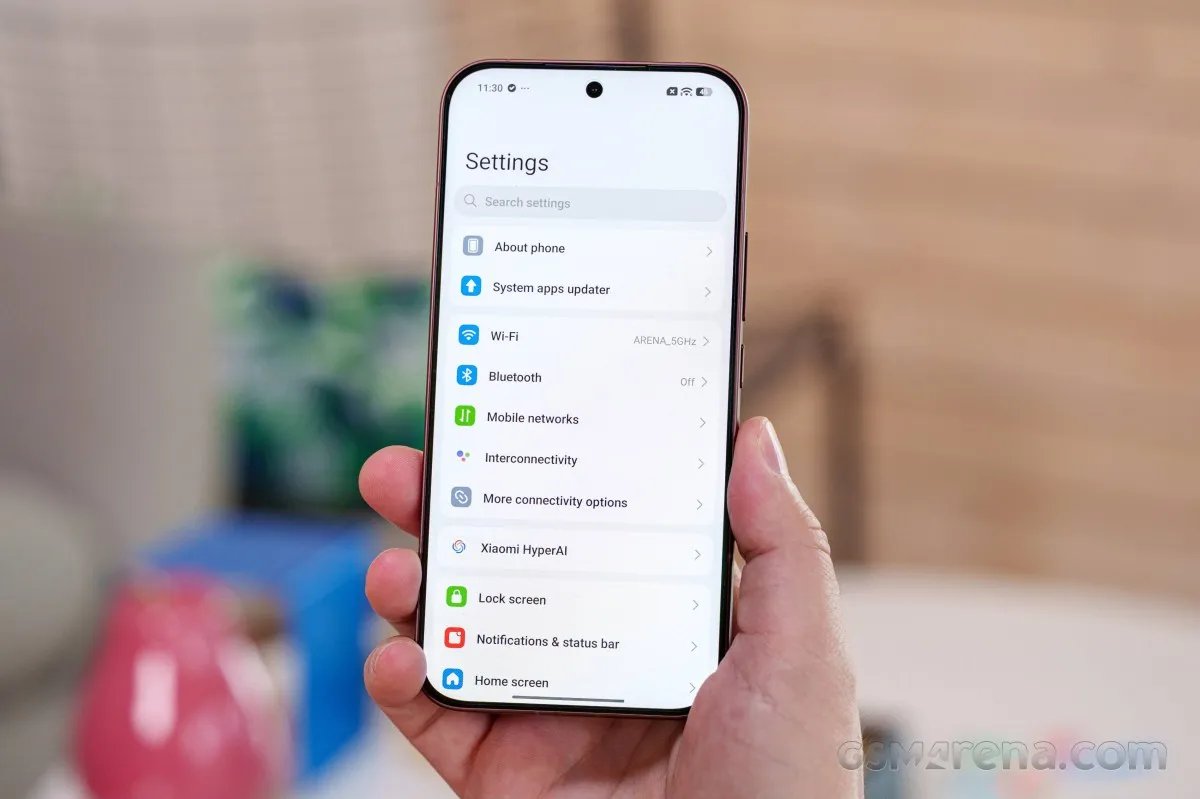
The HyperAI features, on the other hand, seem to be the same ones as before. Though the menu housing them in settings seems to be renamed to "Xiaomi HyperAI". You can ask the AI to help you with your writing, transcription, translation or even show subtitles when watching videos on YouTube. You can make dynamic wallpapers out of still images.

We aren't sure these two menus are absolutely new, but we think they are a bit different and more option-rich on the F9 Ultra. Feel free to correct us. Xiaomi Vision Care, at the very least, seems to list more certifications. By the way, the F9 Ultra has no shortage of these: TÜV Rheinland Low Blue Light (Hardware Solution) Certified, TÜV Rheinland Flicker Free Certified, TÜV Rheinland Circadian Friendly Certified and TÜV Rheinland Intelligent Eye Care Certified.
Then there is the menu to toggle the display processing chip on and off, which we mentioned already.
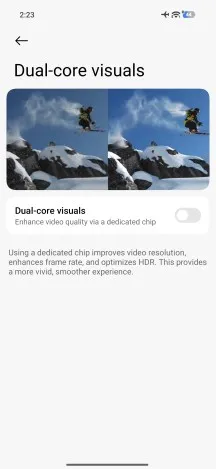
Lastly, Xiaomi says it has made a number of under-the-hood optimizations aimed at improving HyperOS 3's efficiency and performance. As is often the case with such claims, these aren't particularly easy to quantify, so we'll mostly have to take Xiaomi's word for it.
What we can say is that HyperOS 3 felt consistently smooth and snappy during our time with it. We had no complaints in terms of general performance or responsiveness.
Performance and benchmarks
The Poco F8 Ultra is technically a 2025 device, while the F9 Ultra is a 2026 one but there is barely 9 months or so between their respective releases. And unfortunately, there is no generational jump in hardware. The F9 Ultra uses the exact same Snapdragon 8 Elite Gen 5 chipset as the F8 Ultra.
In the CPU department, you are looking at two 4.6 GHz Oryon V3 Phoenix L cores and six 3.62 GHz Oryon V3 Phoenix M cores. The onboard GPU is an Adreno 840. Frankly, that's about as good as the smartphone space currently has to offer.
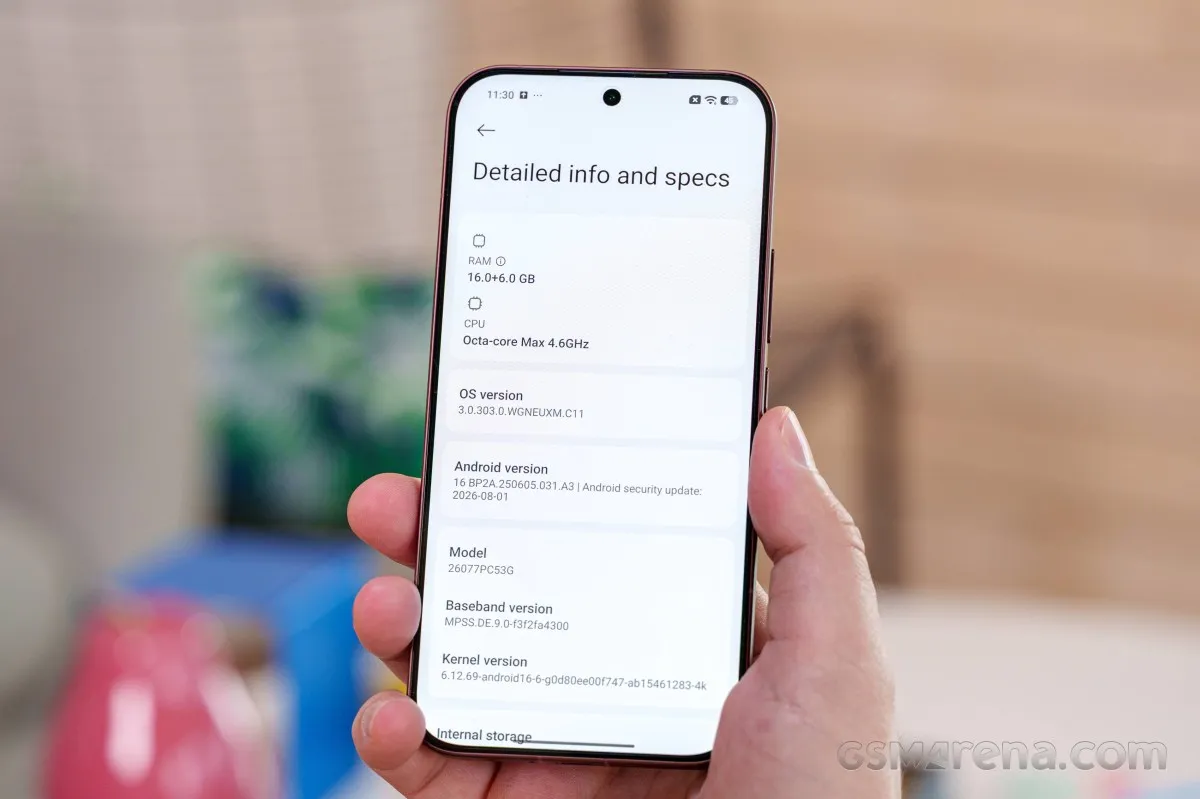
The memory configuration is also mostly identical to last year. RAM is still LPDDR5X at 9600 Mbps, and for storage, you still get fast UFS 4.1 chips. No change there.
The first two device tiers are also familiar: 12GB RAM plus 256GB storage and 16GB RAM plus 512GB storage. This year there is a top-tier 16GB RAM and 1TB storage model as well. We have the latter one for review, so all the benchmark results come from it.
As is usual with the Xiaomi phones, which we get to review pre-release, some benchmarks are limited to avoid leaking details ahead of time. Poco is actually one of the stricter manufacturers when it comes to this point, so we could only test the CPU performance on the F9 Ultra using Geekbench.
GeekBench 6
- Single-core
- Multi-core
 Galaxy S26 Ultra
 Poco F8 Ultra
 Xiaomi 17 Ultra
Poco F9 Ultra
Xiaomi 17 Pro Max
Xiaomi 17T
Xiaomi 17 Ultra
Poco F9 Ultra
Xiaomi 17 Pro Max
Xiaomi 17T
 Poco X8 Pro
Thermal-throttling
The Poco F9 Ultra gets pretty hot, no two ways about it. Poco says it has "LiquidCool Technology with 3D dual-layer IceLoop system", which sounds fancy, but doesn't seem to handle the heat output of the Snapdragon 8 Elite Gen 5 all too well. And while pretty much no phone can properly tame that chip, the F9 Ultra seems to be having a particularly tough time with it, looking at its thermal throttling.
As noted earlier, we couldn't run the 3DMark benchmark reliably.
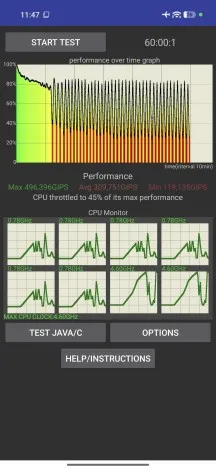
Thermal-throttling
The F9 Ultra also gets uncomfortably hot during prolonged stress testing. This is not necessarily a bad thing when it comes to pulling heat away from the chipset and dissipating it, but it is pretty bad for user comfort. That said, these are all unrealistic synthetic loads, and Poco's WildBoost Engine should be more than capable of delivering good actual in-game frame rates for actual real-world use. Just don't expect your hands to stay sweat-free in the process.
Camera - photo and video quality
200MP main camera, 5x zoom, the usual selfies
The Poco F8 Ultra was a major step up in terms of camera hardware, so it would have been understandable if the F9 Ultra took a more cautious approach to upgrades. It's still mostly the same triple setup on the back, but with a different main camera - a new 200MP sensor replaces the 50MP one of the previous generation.
Note that new higher-res camera is actually using a smaller sensor, which is not ideal. The new unit's optical format is 1/1.56, with 0.5µm individual pixels, binned 16-to-1 into 2.0µm resulting 'pixels'. The old sensor was larger, at 1/1.31" and 2.4µm combined pixels. So this new main camera is more of a sidegrade.
Hardware apps don't really reveal the models of the sensors, but the Samsung Isocell HP5 is a relatively safe bet, though a SmartSens imager (SCC62HS) is also a possibility.
The key numbers haven't changed on the other cameras, it's just that there are no names in the manifest. The 5x zoom telephoto just might still be using the Isocell JN5 that the F8 Ultra used, with a lens that's somewhere between 114mm and 120mm equivalent, depending on where exactly you get your information.
As for the ultrawide, we are probably looking at the same OmniVision OV50M40 sensor - the key specs certainly match. It's a moderately odd pairing of a 50MP sensor with a fixed-focus lens.
The selfie camera is seemingly unchanged as well, a 32MP sensor behind a fixed-focus lens - pretty standard stuff.
- Wide (main): 200MP (1/1.56", 0.5µm - 2.0µm), f/1.68, 24mm, PDAF, OIS; 4K60/8K30 video recording.
- Telephoto, 5x: 50MP (1/2.76", 0.64µm - 1.28µm), periscope lens, f/3.0, 114mm, PDAF (29cm - ∞), OIS; 4K60.
- Ultrawide: 50MP (1/2.88", 0.61µm - 1.22µm), f/2.4, 18mm, fixed focus; 4K60.
- Front camera: 32MP (1/3.4", 0.61µm - 1.22µm), f/2.2, 22mm, fixed focus; 4K30/1080p60.

Daylight photo quality
Main camera
The Poco F9 Ultra's main camera takes properly great daytime photos at 1x. They have excellent dynamic range and well-judged color saturation, for an easily likable overall look. Detail is top-notch too - everything is nice and sharp and the processing isn't too liberal on the sharpening.










Portraits are also great from the Poco F9 Ultra - skin tones have no odd color casts, the Portrait mode blur is conservative and quite believable.
The 50MP photos at 1x don't strike us as particularly sharp, and we wouldn't say they resolve any more detail.




Shooting in 200MP is a bit of a drag as it takes a while to capture and in the end you're left with 30-40-50MB files, even upwards of 70MB if it's an outdoor scene with a lot of greenery. Still, the files do hold potential for extracting extra detail though you'd be wise to downscale them in post processing. We chose something around 24MP as a target resolution and the photos are indeed significantly more detailed than the regular 12.5MP ones. It does, admittedly, take a few extra steps, and it's not applicable for all scenes (you need good lighting) or all subjects (still scenes only).
Now that we know that the sensor holds serious detail potential, it's no surprise that the out-of-camera regular resolution 2x photos are excellent too.







That holds true with headshots as well, where you'll be getting great facial detail and the pleasing skin tones we already saw at 1x. The Portrait mode results are also looking very natural.
There's an additional 3.1x zoom level in Portrait mode which may sound like an odd choice, but it corresponds to a 75mm equivalent focal length and that makes it make sense. It's a welcome addition if you like the tighter frame, plus detail remains very good, even with that extra crop.
Telephoto camera
The telephoto camera also takes great photos. They have a lot of detail and that detail is rendered reasonably well. Contrast is a touch too high, but not really to a point of being an issue, and colors have just the right amount of pop.












The 5x headshots are also easy to like thanks to their great subject detail and the nice perspective compression. Skin tones can be slightly on the oversaturated side in outdoor lighting, but that too is hardly a problem. Subject separation is plenty good enough in Photo mode, but you can certainly get some extra background blur in Portrait mode and that too is looking good.
The 50MP photos have a distinctly watercolor-like detail rendition and we wouldn't really say they're of much use.




10x zoom photos can often have somewhat different white balance than the corresponding 5x ones, which struck us as a bit odd. They have alright detail - slightly better than the 50MP 5x shots more often than not, and with more sharpening and better definition. They're not the best 10x shots we've seen, but they're not half bad either.











Ultrawide camera
The ultrawide camera does an alright job for the most part. Its most glaring issue is the lack of autofocus, which means that nearby subjects will be out of focus. That was also the case with the previous-gen Ultra, but here it's somehow more pronounced - why they would have changed that is beyond us, but here we are.
For distant subjects in good lighting you can count on very good detail as ultrawide cameras go. Things get softer in dimmer conditions, but not dramatically so. Colors and dynamic range are hard to fault.








The full-res mode doesn't bring any tangible detail benefits.




Close-ups
There are two approaches to close-ups on the Poco F8 Ultra - one is to shoot on the main camera at 2x ( possibly maybe slightly beyond that), and the other is on the telephoto camera, either at its nominal 5x or at 10x. Reproduction at minimum focusing distance is the largest at 10x, followed by the main camera's 2x, and then it's the telephoto's 5x native focal length.
In our book, the best balance between quality and reproduction is at 2x. That said, shooting on the telephoto comes with the benefit of staying further from your subject, which could be a consideration with easily scared (or potentially dangerous) subjects. Pixel-level quality at 10x zoom at this subject distance isn't spectacular though, but 5x is pretty good.
Selfies
As usual, we're not fans of the 32MP label on the selfie camera or the fact that it outputs 32MP photos only - there's just not that much detail in there and there's no need to be saving 8-10MB files with little practical use. That said, the images are great in the other meaningful ways - dynamic range is nicely wide, skin tones are lively, and colors are looking good overall. So if you don't pixel-peep or if you resize the photos to a more sensible resolution, they're pretty nice selfies, all things considered.
The lack of autofocus doesn't seem to be that big of a deal either, since the chosen focus distance and the depth of field do appear to cover pretty short shooting distances quite well.








Low-light photo quality
Main camera
The main camera's low-light photos are very good. They have very well controlled highlights and good shadow development, though there's just a hint of a general air of darkness. The auto white balance is unfazed by odd lighting and saturation is also quite pleasing. Detail is great and is generally not too processed-looking, though there are outliers - like the concrete wall in the fourth scene, which could be at least a little less sharpened.








The 2x zoom photos at night aren't quite as exciting as the daytime ones, but they're still very good and better than most potential competitors or even some proper high-end models.







Telephoto camera
The telephoto camera's 5x zoom photos are solid. There's been some tweaking from the old generation to this one and the images are notably less grainy, though the new look can be somewhat plasticky and we're not sure that's better. Either way, there's no shortage of detail. We'd probably prefer brighter exposures, or at least a shadow boost, but maybe this current approach has its fans too.








The 10x photos dial up that plastickyness even higher and it's not our favorite - grass and brickwork look almost completely made-up. In other types of subjects it's nowhere as noticeable though. In any case, if you refrain from up-close examination, you'll likely be perfectly happy with the results.








Ultrawide camera
The ultrawide, while still a decent performer, isn't really in its element at night. There's a general softness and some shadows get completely flattened. It struggled with getting the colors right with some types of lighting too.








Photo quality verdict
The Poco F9 Ultra is generally a competent stills camera with flashes of greatness here or there, but also some shortcomings. The ultrawide camera is the least exciting module, lacking autofocus and generally underdelivering, particularly at night. The telephoto is properly excellent in daytime and reasonably good at night at 5x, though it delivers slightly questionable detail rendition at 10x in all kinds of light. The main camera is a top-class performer at 1x and 2x, it offers extra resolving power if you go through some hoops with its 200MP files, and its low-light results are also easy to like. Selfies are pretty great too - if only there was a readily available lower-res mode.
Video quality
The Poco F9 Ultra can record video up to 4K60 with all of its rear cameras, with the main one adding 8K30 capability on top of that. The selfie camera maxes out at 4K30 (or 1080p60 if you're willing to trade resolution for more frames). There's no 24fps capability, not even in the Pro video mode.
The default codec is h.265 but you can switch to h.264. The phone can record in HDR10+ if you enable the toggle in settings (a more accessible button in the viewfinder would be welcome) and it's available for all resolution/frame rate settings on all four cameras, minus the main camera's 8K30.
The Pro video mode has a Log recording mode with a handful of live preview LUTs, plus the option to import your own. The usual features are available here, including audio level monitoring, zebras for highlight clipping, and a tiny histogram, which can be switched for a tiny waveform - pretty solid.
There's an always-on regular electronic video stabilization for all resolutions and frame rates.
You can hit '> play' below and use the '>| next' button to advance through the playlist of all video samples, or you can watch the full playlist on YouTube.
You can count on some very good daytime videos from the F9 Ultra. Dynamic range is wide, contrast is great, white balance is on point and colors have a likeable level of pop to them. Detail is also very good and has an organic rendition. The 2x clips can be a little dreamy in their detail rendition, but they're still quite alright. The telephoto also returns detailed clips with great global properties. It's the ultrawide that can't quite earn good marks for sharpness (as was the case with the previous generation, for that matter), but it does have the main camera's colors and dynamic range, which is always a great thing to see.



In the dark, the main camera maintains a pretty solid level, nailing the white balance and saturation, and having excellent dynamic range. Detail is good too, though things can be sharper, after all. 2x clips are soft and noisy, but possibly usable if you absolutely must. 5x footage is very good when it comes to detail and it's also hard to fault in terms of colors and dynamic range. 10x is just about usable as well. The ultrawide's footage is dark and somewhat lacking in dynamic range, prus it's pretty soft.




There's not much to complain about when we get to stabilization. On the previous generation's telephoto we observed a certain nervousness, which has been significantly reduced here, and the main and the ultrawide cameras are also nicely stable if you just point them in one direction. Panning is nicely smooth too. Walking shake on the main camera isn't perfectly taken care of, but maybe those tremors we're seeing won't be there if you don't go looking for them.
Video quality verdict
The Poco F9 Ultra is plenty capable as a video camera, featuring 4K60 on all rear cameras and 4K30 on the front, with HDR10+ available across the board. The Pro mode has a host of advanced features too. Video quality is very good on the main camera and the telephoto in both good light and at night, while the ultrawide is alright during the day, and not particularly likeable in the dark. Stabilization is generally very good.
Final words, our verdict, pros and cons
The competition
Poco is unfortunately not immune to the ongoing memory chip shortage and the resulting price hikes. Granted, the increase isn't the most extreme we've seen, but it is definitely there. For reference, pricing for the F8 Ultra last year started at £749/$729/€830 for the 12GB/256GB trim, with an early-bird price of €649/$679/£549. It is pretty hard to find trustworthy listings for it nowadays, but we still managed to find a few around the €650 mark, though we doubt stock will last much longer.
Meanwhile, the F9 Ultra has an official MSRP of $799/€1,099 for the base 12GB/256GB version, with an early-bird price of $729/€829.90. The 16GB/512GB version will run you $949/€1,199.90 ($799/€899.90 early-bird), while the new 16GB/1TB version commands $1,199/€1,399.90 ($1,059/€1,199.90 early-bird).
If we assume the usual price fluctuation logic still applies to the market in these strange times we are living in, it's likely that the official MSRP will only stick for a couple of months before prices settle back down to around early-bird levels. At least we can hope so. So, let's be optimistic here and set our threshold for competitors at around €850.
By the way, one quick clarification - the Xiaomi Redmi K100 Pro Max seems to be almost identical to the Poco F9 Ultra, just with an even bigger battery. It's not really sold globally, so we won't pay any attention to it.
The Poco X8 Pro Max is probably the most obvious place to look if you like what the F9 Ultra has to offer but don't necessarily need the premium features like the telephoto camera or the BOSE subwoofer. The overall experience is otherwise very similar, while the X8 Pro Max comes in at a sub-€500 price point. That is a substantial saving, and it makes the X8 Pro Max particularly difficult to ignore.


Then there is the Xiaomi 17T Pro, which arguably makes an even stronger case against the F9 Ultra. You do get a proper telephoto camera here, while the battery is only slightly smaller at 7,000 mAh. More importantly, for roughly €50 less than the F9 Ultra, the 17T Pro can be had with 512GB of storage. The rest of the experience is broadly comparable, so the combination of lower price and twice the storage makes the Xiaomi an especially compelling alternative.
The Motorola Edge 70 Max is comparable to the F9 Ultra in many respects, though it once again misses out on a dedicated telephoto camera. The Edge 70 Max remains an interesting proposition thanks to its gorgeous LTPO display, large battery and the clean, lightweight software experience Motorola is known for. Those things alone could be enough to sway some buyers its way.
Finally, there is the OnePlus 15. It is slightly older than the Poco, but it remains OnePlus' last flagship and is surprisingly competitive compared to the F9 Ultra. The display comparison is particularly interesting - the OnePlus panel is arguably inferior in a few respects, but it is LTPO. OnePlus has also scaled back its operations recently, which introduces a degree of uncertainty regarding long-term updates, servicing and repairs. Still, while stock remains available, the OnePlus 15 is well worth considering if you can find it at a bargain price.
Samsung doesn't seem to target this particular price bracket in any obvious way. Still, if you really want One UI and Samsung's extended software support promise, then the Galaxy S26+ is probably your best bet at this price. Unless you are willing to shop for new old stock, for instance and get great deals that way, like the Galaxy S25 Ultra, but that's a whole other bag of worms we won't get into.
Our verdict
The Poco F9 Ultra is a very easy phone to like and a surprisingly difficult one to recommend without reservations. Those two things are not contradictory. Taken entirely on its own, this is an excellent flagship with very few meaningful weaknesses. The problem is that Poco already got so much right with the previous generation that the F9 Ultra feels more like a careful refinement than a transformative upgrade.
There is certainly plenty here to be impressed by. The 6.9-inch AMOLED is one of the brightest displays we have measured and is an excellent panel in practically every other respect too. It is sharp, fast, HDR-capable and backed by Poco's dedicated display processing hardware for gaming. The 185Hz headline figure relates to a rather niche use, but the actual high-refresh-rate handling is still excellent.
Battery life is arguably even more impressive. The huge 8,050mAh battery translates into superb endurance, and managing to fit that much capacity into a body that is still recognizably a normal flagship smartphone is an achievement in itself.
The Snapdragon 8 Elite Gen 5 remains immensely powerful, even if it is exactly the same chipset found in the F8 Ultra. Performance is certainly not something the F9 Ultra lacks, but thermal behavior is less convincing. The phone gets quite hot under sustained heavy loads and throttles noticeably. Real-world gaming should still be perfectly fine, but this is clearly not the best implementation of Qualcomm's flagship silicon.
The audio experience remains one of the F9 Ultra's more unusual strengths. The symmetrical stereo speakers and dedicated rear subwoofer produce genuinely excellent sound with unusually convincing low-end response for a phone. The whole 2.1 setup may no longer be new to the series, having debuted on the F8 Ultra, but it remains distinctive in the wider smartphone market.
The camera system is similarly capable without being exceptional in any way. The new 200MP main camera is the standout, producing excellent photos at both 1x and 2x, with very good low-light results and some genuine extra resolving potential if you are willing to work with the huge 200MP files. The 5x telephoto is reliable and useful, while selfies are very good too. The ultrawide remains the weak link, particularly because it still lacks autofocus and falls apart somewhat in low light. Video recording is strong overall, especially from the main and telephoto cameras, and the Pro video features are unusually extensive.
Elsewhere, the F9 Ultra checks almost every flagship box. Build quality is excellent, IP68 protection is present, the ultrasonic fingerprint reader works very well, connectivity is extensive, HyperOS 3 is smooth and feature-rich. We would have liked 6 GHz band Wi-Fi support and video output over USB, but neither omission is likely to be a deal-breaker for most buyers.
And this brings us back to the awkward part: price. The F9 Ultra does improve on its predecessor, most notably with its enormous battery, brighter display and new 200MP main camera. The trouble is that none of those upgrades fundamentally changes the experience. The chipset is the same, the audio setup is essentially the same, the camera system is evolutionary rather than revolutionary, and the overall formula remains very familiar.
Meanwhile, the asking price has gone up dramatically. We understand that Poco is operating in the same difficult component and memory market as everyone else, and this may simply be what smartphone pricing looks like going forward. We are just having a hard time adjusting to it. It is particularly difficult to ignore while some F8 Ultra stock is still floating around at old-world prices.
Ultimately, there is very little wrong with the Poco F9 Ultra itself. It is fast, beautifully built and has an exceptionally long-lasting battery, superb display, excellent speakers and a capable camera system. It is one of the better all-round flagship packages currently available. But at €1,099 MSRP, it also asks you to pay considerably more for an experience that, in broad strokes, Poco was already offering last year.
At the early-bird price, and especially once inevitable discounts start appearing, the equation becomes much easier. Until then, the Poco F9 Ultra is best described as an excellent iterative upgrade caught at an unfortunate moment in the market. We like the phone a lot. We just don't like paying extra for things that feel so familiar.
Pros
- Excellent premium build.
- Outstandingly bright and fast AMOLED display.
- Superb battery life.
- Excellent stereo speakers with dedicated subwoofer.
- Top-tier Snapdragon 8 Elite Gen 5 performance.
- Top-notch main camera; standout 5x telephoto.
Cons
- Somewhat heavy.
- Major price hike compared to the previous generation.
- Runs hot and throttles heavily under prolonged load.
- Ultrawide camera still lacks autofocus.